Films 1997
1997
Die Bewerbung
The Interview
 
In the summer of 1996, we filmed application training courses in which one learns how to apply for a job. School drop-outs, university graduates, people who have been re-trained, the long-term unemployed, recovered drug addicts, and mid-level managers - all of them are supposed to learn how to market and sell themselves, a skill to which the term "self management" is applied. The self is perhaps nothing more than a metaphysical hook from which to hang a social identity. It was Kafka who likened being accepted for a job to entering the Kingdom of Heaven; the paths leading to both are completely uncertain. Today one speaks of getting a job with the greatest obsequiousness, but without any grand expectations. (Harun Farocki)
director, scriptwriter: Harun Farocki
cinematographer: Ingo Kratisch
second cinematographer: Bernd
Löhr editor: Max Reimann sound:
Ludger Blanke music: Neil Young
researcher: Ludger Blanke
production: Harun Farocki Film-
produktion, Berlin, for den Süd-
deutschen Rundfunk, Stuttgart
producer: Harun Farocki
TV-producer: Juliane Endres
length: 58 min. format: video -
BetaSp, col., 1:1,37 first
broadcast: 18.02.1997, arte
commissioned for the TV series
La vie en face / Welt im Blick
 
76
1997
Die Werbebotschaft
 
From material produced for Der Auftritt / The Appearance. Contribution to the magazine program Brut (arte). (production statement)
director, scriptwriter: Harun
Farocki cinematographer: Ingo
Kratisch second cinematographer:
Rosa Mercedes editor: Max Reimann
sound: Ronny Tanner
production: Harun Farocki Filmproduction,
Berlin producer: Harun Farocki executive
producer: Ulrich Ströhle TV-producer: Inge
Inge Classen length: 3 min. format:
video-BetaSp, col., 1:1,37 first broadcast:
04.04.1997, arte
 
1997
Stilleben
Still Life
 
According to Harun Farocki, today's photographers working in advertising are, in a way, continuing the tradition of 17th century Flemish painters in that they depict objects from everyday life - the "still life". The filmmaker illustrates this intriguing hypothesis with three documentary sequences which show the photographers at work creating a contemporary "still life": a cheese-board, beer glasses and an expensive watch.
director, scriptwriter: Harun
Farocki cinematographer: Ingo
Kratisch editor: Irina Hoppe, Rosa
Mercedes, Jan Ralske sound:
Ludger Blanke, Jason Lopez, Hugues
Peyret mixing: Gerhard Jensen-Nelson
collaboration: Jörg Becker, Dina
Ciraulo, Cathérine Mariette narrator:
Hanns Zischler production: Harun
Fatocki Filmproduktion, Berlin,
Movimento Production (Christian
Baute, Pierre Hanau), in coproduction
with ZDF/ 3sat, RTBF-Carré Noir
(Christiane Philippe), Latitudes
Production (Jacques-Henri Bronckart),
ORF (Dr. Heinrich Mis), in
collaboration with NOS TV The
Netherlands Programme Service (Cees
van Ede), Planète Cable (Michel
Badinter), with support from Centre
National de la Cinématographie, France,
documenta X (Brigitte Kramer) TV-producer:
Inge Classen length: 56 min. format: 16mm,
col. first screening: August 1997, documenta X
first broadcast: 07.09.1997, 3sat
 
78
1997
Das Bild der Uhr
 
From material produced for Stilleben / Still Life. Contribution to the magazine program Brut (arte). (production statement)
length: 3 min. format: 16mm, col. first broadcast:
19.09.1997, arte
 
 
1997
Der Ausdruck der Hände
 
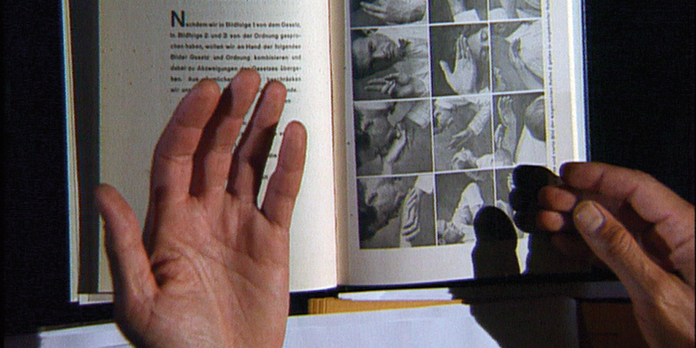
Historically, the cinema close-up was initially employed to convey emotions through facial expressions. But soon filmmakers also began focusing their attention on hands. Using film extracts, Farocki explores this visual language, it's symbolism, Freudian slips, automatisms and its music. Often, hands betray an emotion which the face tries to dissimulate. They can also function as a conduit (exchanging money) or witness to a form of competence (work)
director: Harun Farocki scriptwriter:
Harun Farocki, Jörg Becker cinemato-
grapher: Ingo Kratisch sound: Klaus
Klingler editor: Max Reimann
researcher in the USA: David Barker,
Tom Bigelow length: 30 min. format:
video-BetaSp, 1:1,37 production:
Harun Farocki Filmproduktion, Berlin,
for WDR TV-producer: Werner Dütsch
first broadcast: 07.09.1997, 3sat