In Europe in the fall of 1989, history took place
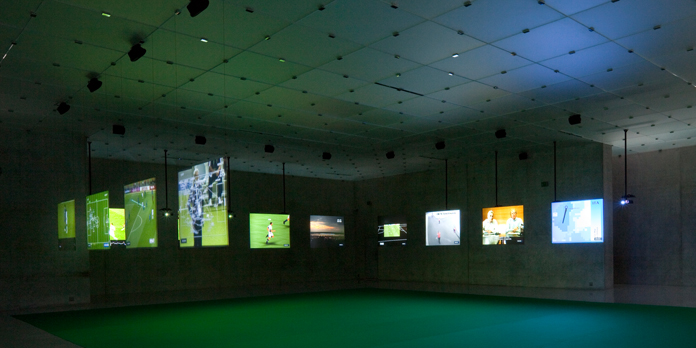
before our very eyes. Farocki and Ujica's "Videograms" shows the Rumanian revolution
of December 1989 in Bucharest in a new media-based form of historiography. Demonstrators
occupied the television station [in Bucharest] and broadcast continuously for
120 hours, thereby establishing the television studio as a new historical site.
Between December 21, 1989 (the day of Ceaucescu's last speech) and December
26, 1989 (the first televised summary of his trial), the cameras recorded events
at the most important locations in Bucharest, almost without exception. The
determining medium of an era has always marked history, quite unambiguously
so in that of modern Europe. It was influenced by theater, from Shakespeare
to Schiller, and later on by literature, until Tolstoy. As we know, the 20th
century is filmic. But only the videocamera, with its heightened possibilities
in terms of recording time and mobility, can bring the process of filming history
to completion. Provided, of course, that there is history. (Andrei
Ujica) Harun Farocki conceived of and assembled Videograms of a Revolution
together with Andrei Ujica. Ujica, who was born in Timisoara in 1951, is a Rumanian
writer who has been living in Germany since 1981, where he is a lecturer in
literature and media theory. He has good connections to Rumanian friends and
colleagues who not only opened up the television archives to the authors but
also enabled them to get in contact with cameramen from state film studios and
with numerous amateur videographers who had documented the events on the streets
of Bucharest, often from the roofs of highrise buildings. "If at the outbreak
of the uprising only one camera dared to record," said Farocki, "hundreds were
in operation on the following day." (Dietrich Leder, Film-Dienst
24/92)